What Are MemoHoney Capsules?
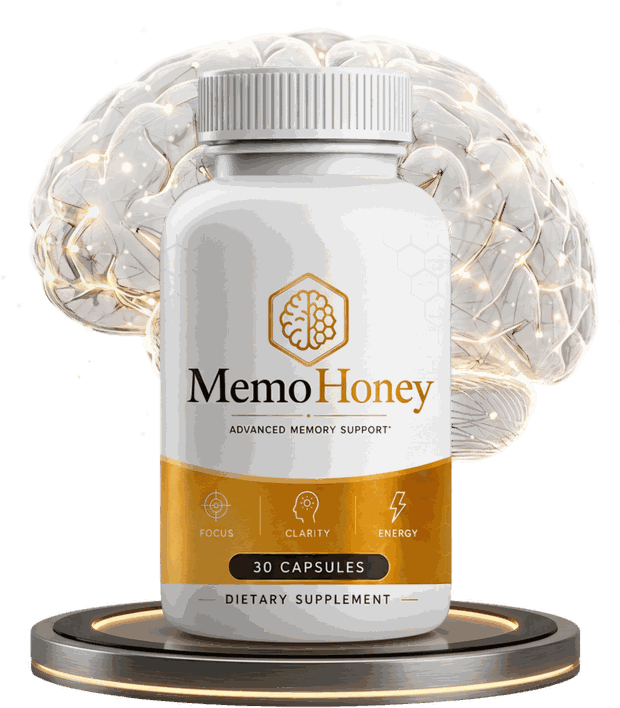
MemoHoney Capsules are marketed as an advanced memory support dietary supplement. The presentation is straightforward: a white bottle with a honeycomb-and-brain emblem, thirty capsules per container, and three promised outcome areas printed across the gold band — focus, clarity, and energy. The name itself signals the two ideas the brand is leaning on: memory performance and the long folk association between honey, bee products, and mental sharpness.
The category MemoHoney sits in is usually called nootropics or cognitive support. These products do not claim to be medicines. They are sold as food supplements intended to fill gaps in a daily routine — the kind of gaps that open up when you sleep six hours instead of eight, skip meals, sit through long screen-heavy days, and then wonder why names, passwords, and half-finished thoughts keep slipping away. That is the exact frustration this product is written for, and it is a real frustration. Whether a capsule is the right answer to it is the question this review is built around.
Our position is simple and we will repeat it: we are an independent editorial site, not the manufacturer. We did not formulate the product, we do not ship it, and we cannot confirm claims that the seller has not documented publicly. What we can do is show you how to read a supplement like this properly, what the honest upside looks like, where the risks sit, and which specific things to verify on the official page before any money leaves your account.
Buying MemoHoney Capsules?
Order only through the official product page so your purchase is covered by the seller's stated refund window and batch documentation.
Check Official MemoHoney PriceAffiliate link — we may earn a commission at no extra cost to you.
How Memory Support Formulas Are Supposed to Work
Cognitive supplements generally act through a small number of well-known mechanisms rather than anything exotic. Understanding those mechanisms is the fastest way to separate a reasonable product from marketing noise.
1. Circulation and oxygen delivery
The brain is roughly two percent of body weight but consumes around twenty percent of the body's oxygen and glucose. Ingredients traditionally used in this space — ginkgo biloba being the most famous — are included on the argument that better microcirculation means better delivery of fuel to brain tissue. When people describe a "lifting fog" sensation from a nootropic, circulation-linked ingredients are often the reason.
2. Neurotransmitter raw materials
Acetylcholine is the neurotransmitter most closely tied to learning and recall. Formulas in this category often include choline donors such as alpha-GPC or citicoline, or a precursor-style ingredient intended to keep that pathway supplied. This is where the "memory" claim usually originates.
3. Stress load and cortisol
Chronic stress is one of the most reliable destroyers of working memory. Adaptogens like ashwagandha, rhodiola, and bacopa monnieri are used to blunt the stress response rather than stimulate the brain directly. People often report that these feel less like a boost and more like the absence of static.
4. Oxidative protection
Antioxidant components — vitamin E, polyphenols, honey-derived compounds, bee propolis extracts — are positioned as long-horizon protection for cell membranes rather than same-day performance. Nothing here produces a noticeable effect in a week, which is exactly why honest products in this space quote timelines in months.
5. B-vitamin and micronutrient cover
B6, B9, and B12 are involved in homocysteine metabolism and nerve function. If someone is genuinely low on them, correcting that can produce a real and sometimes dramatic change in mental energy. If they are not low, additional intake typically does very little. This is the single most common reason two people take the same bottle and report opposite results.
Reading the MemoHoney Label the Right Way
Before ordering, open the official page and look for the supplement facts panel. There are four things worth checking, in order of importance.
- Per-ingredient dosages, not just names. A list of impressive botanicals means nothing without milligram amounts. Compare each amount against the dose used in published research on that ingredient.
- Proprietary blends. If several ingredients are grouped under a single total weight, you cannot know whether the valuable component is a meaningful dose or a token sprinkle. This is legal and common, but it limits what you can verify.
- Standardisation markers. Quality botanical extracts state their active percentage — for example bacopa standardised to bacosides. Absence of a marker is not proof of a weak extract, but its presence is a good sign.
- Allergens and additives. Capsule shell material (gelatin versus vegetarian cellulose), soy, dairy, shellfish derivatives, and honey or bee-product content all matter for vegans and for anyone with bee allergies. Bee-derived ingredients are a genuine contraindication for a small group of people.
One serving of the honest truth: because formulations are updated over time and regional versions differ, the panel shown on the official page at the moment you buy is the only version that binds. Screenshot it. If a support agent later tells you something different, that screenshot is your evidence.
MemoHoney Pricing and Package Structure
Supplements in this category almost always use tiered pricing: one bottle at the highest per-unit cost, a three-bottle bundle at a mid price, and a six-bottle bundle at the lowest per-bottle rate, sometimes with free shipping or a digital bonus attached. MemoHoney follows that familiar structure, and the current numbers are shown on the official page rather than here — deliberately, because promotional pricing on these products changes frequently and a stale figure on a review site helps nobody.
Our practical advice on package selection:
- First-time buyers: start with the smallest package your budget tolerates, even though the per-bottle price is worst. You are buying information about how your own body responds, not a year of supply.
- Returning buyers: the multi-bottle tier only makes sense once you have personally confirmed a benefit over four to eight weeks and have checked the expiry dates you would be committing to.
- Watch for auto-billing language. Read the checkout page for the words "subscription", "recurring", "auto-ship", or "trial". A one-time purchase should say so explicitly. If a recurring charge is involved, note the cancellation method before paying.
- Total landed cost. Shipping, customs, and currency conversion can change the real price meaningfully on international orders. Compare the final checkout total, not the headline number.
Buying MemoHoney Capsules?
Order only through the official product page so your purchase is covered by the seller's stated refund window and batch documentation.
See Current Pricing & PackagesAffiliate link — we may earn a commission at no extra cost to you.
Dosage, Timing, and How Long to Give It
Follow the label rather than any advice found online, including ours. For a thirty-capsule bottle, the typical instruction is one capsule per day with water, taken with a meal. Taking a supplement with food matters more than people assume: fat-soluble components absorb better alongside a meal containing some fat, and capsules taken on an empty stomach are the most common cause of mild nausea.
On timing, morning is the sensible default for anything positioned around focus and energy. If a formula contains stimulant-adjacent ingredients, taking it late can interfere with sleep — and disrupted sleep will erase any cognitive benefit the capsule could possibly deliver. Sleep is the non-negotiable foundation underneath every nootropic claim ever made.
On patience: honest expectations are four to twelve weeks. Adaptogens and choline pathway support build gradually. If you take a product for five days, feel nothing, and quit, you have not really tested it. Conversely, if you feel a dramatic same-hour transformation, that is usually caffeine or a stimulant, not memory architecture being rebuilt.
Keep a two-line daily note for a month — sleep hours and a one-to-ten focus score. This single habit outperforms guesswork, because memory of your own mental state is exactly the thing you are trying to improve and therefore the least reliable evidence available.
Who Should Not Take It
This is the section most sales pages under-serve, so we will be direct. Do not start MemoHoney Capsules, or any comparable supplement, without medical clearance if you are:
- pregnant, planning pregnancy, or breastfeeding;
- under eighteen years old;
- taking blood thinners such as warfarin, or antiplatelet medication — several circulation botanicals interact with these;
- on antidepressants, thyroid medication, sedatives, or blood pressure medication, where herbal interactions are documented;
- scheduled for surgery within two weeks, due to bleeding-time considerations;
- allergic to bees, honey, propolis, or royal jelly;
- living with a diagnosed neurological or psychiatric condition.
Memory loss also has causes that a supplement cannot touch: thyroid dysfunction, B12 deficiency, sleep apnoea, depression, medication side effects, and early neurodegenerative disease. All of them are worth ruling out with a doctor. A capsule is a poor substitute for a blood test, and treating a diagnosable condition with a supplement is the one genuine harm this category can cause.
Realistic Pros and Cons
What works in its favour
- Simple one-capsule-a-day routine that people actually stick to.
- Clear positioning around three understandable outcomes rather than vague promises.
- Single-channel official ordering, which reduces counterfeit exposure.
- Bundle pricing that meaningfully lowers cost for committed long-term users.
What gives us pause
- Marketing in this category routinely outruns the evidence; treat dramatic before-and-after stories as advertising.
- Results are highly individual and depend heavily on whether you had a nutrient gap to begin with.
- Third-party lab testing is not universally published in this space — ask for it.
- Not available in mainstream retail, so independent price comparison is limited.
Refunds, Delivery, and Support Checks
Before paying, confirm five things in writing on the official page: the exact length of the money-back window and when it starts; whether opened bottles qualify; who pays return shipping; the return address; and the support email or ticket system that handles refunds. Also note the stated delivery estimate for your country and the tracking method. Keep the order confirmation email — it is the document that resolves almost every dispute.
If a page promises a guarantee but never states the number of days, treat that as a material gap and ask support directly before ordering. A legitimate seller answers that question in one short reply.
Frequently Asked Questions
Is MemoHoney Capsules a medicine?
No. It is sold as a dietary supplement and is not intended to diagnose, treat, cure, or prevent any disease. Nothing on this site should be read as a medical claim.
How fast will I notice anything?
Expect weeks rather than days. Give it four to twelve weeks of consistent daily use before judging, and track sleep alongside it.
Can I take it with coffee?
Usually yes, but if the formula already contains stimulant ingredients, stacking caffeine on top can cause jitteriness. Start with one source at a time.
Does it contain honey?
The branding implies bee-derived components. Anyone with a bee, honey, or propolis allergy must confirm the exact ingredient list on the official label before use.
Where should I buy it?
Only from the official product page. Third-party listings for products like this are the main source of expired stock, tampered seals, and refund disputes with no recourse.
Final Verdict
MemoHoney Capsules are a conventional entry in the memory-support category: a clean presentation, an easy daily habit, and claims that live or die on the ingredient panel you can read on the official page. If your day-to-day mental fog is driven by stress, poor sleep, and a thin diet, a well-dosed formula in this class can plausibly help at the margins — and margins are not nothing when your work depends on attention. If your memory problems are new, worsening, or interfering with daily life, the correct first step is a doctor, not a bottle.
Buy it as an experiment on yourself rather than a cure. Read the label, screenshot the guarantee, start with the smallest package, take it daily with food for at least a month, write down what happens, and let your own notes decide whether a second bottle is justified. That approach costs nothing and protects you far better than any review can.
Questions about ordering, the label, or refunds? Reach us on the contact page — email, Telegram, and WhatsApp are all listed there and we reply to genuine queries.
Buying MemoHoney Capsules?
Order only through the official product page so your purchase is covered by the seller's stated refund window and batch documentation.
Go to the Official MemoHoney PageAffiliate link — we may earn a commission at no extra cost to you.